 This project has received funding from the European Research Council under the European Union’s Horizon 2020 research and innovation programme
(Grant Agreement n. 669194)
(Plauen, 20/8/1928 - Berlin-Karlshorst, 4/5/1980)
Minister - Ministry of Finance (1966-1980)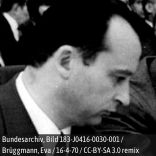
As Minister of Finance Siegfried Böhm was among the first who warned about the potential consequences of growing indebtedness to the West. He was a member of the Working Group Balance of Payments. At the end of the 1970s, Böhm was among those who unsuccessfully recommended drastic price hikes.
|
The President of the East German Central Bank belonged to those economic experts who were permanently aware of the worsening economic and financial situation of the GDR. In the late 1970s he contributed to analyses warning about rising debts a... |
|
As Chairman of the East German State Planning Commission Gerhard Schürer was always part of the inner circle of the GDR’s economic elite. However, his power was limited and Honecker never promoted him to membership in the Politburo.... |
|
Without having direct influence on East German economic and foreign policy, the President of the German Foreign Trade Bank Werner Polze was fully aware of the GDR’s financial situation and played a certain role during the debt crisis, es... |
|
Günter Mittag was the economic mastermind of the Socialist Unity Party of Germany. Within the provisions set by Erich Honecker he executed control over the East German economy. He served as Secretary of the Central Committee for Economics... |
|
As Deputy Minister of Finance, Herta König had first-hand knowledge of the financial situation of the GDR. During the years of the debt crisis, she worked in close collaboration with Alexander Schalck-Golodkowski on the balance of payment... |
|
Current status of the GDR’s balance of payments with the West in 1978/79
BArch-DDR, DL 226/1248 | Bl. 220–238,
This assessment of the GDR's balance of payments produced by the Chairman of the State Planning commission, the Minister of Finance and the country's leading bankers analyzed the causes and consequences of East Germany's growing indebtedness since the early 1970s. Their conclusion stated the obvious: “This spiral cannot be prolonged.” It was entirely clear that “without the willingness of foreign, and especially capitalist banks to provide further loans in the amount needed, the planned imports and the due payment obligations cannot be realized.” Without a fundamental turnaround in the GDR’s trade balance with the West, debt was expected to skyrocket until the mid-1980s. - Available only in the archive: https://www.bundesarchiv.de |